|
Dust removal engineering design manual (1)
2017-06-29
Chapter Three: Control of Dust Source and Design of Air Collector and Dust Hood The air collecting dust hood is an important part of the dust removal system and an important part of the dust removal engineering design. The better the use effect of the air-collecting dust hood means the more it can meet the requirements of production and environmental protection. This chapter mainly introduces the design of commonly used air collecting dust hoods and the calculation of exhaust volume, and also introduces the control method of dust source without hood. The first section the tip and working mechanism of the air collecting dust hood 1. Classification of air-collecting dust hood Due to the different production process conditions and operation methods, the air-collecting dust hood has many forms. According to the function and structure of the air-collecting dust hood, it is mainly divided into four categories; closed cover, semi-closed cover, external cover and blowing and suction cover. The specific classification is shown in Figure 3-1. 2. The mechanism of air collection and dust collection There are two ways of airflow movement at the mouth of the air-collecting dust hood: one is the airflow at the suction port and the suction flow, and the other is the blowing flow of the airflow from the blowing port. In most cases, the air suction port sucks in airflow. 1. Inlet airflow An open nozzle is the simplest inhalation port. When the inhalation port takes the breath, negative pressure is formed near the inhalation port, and the surrounding air flows from all directions to the inhalation port, forming an inhalation airflow or confluence. When the area of the suction port is small, it can be regarded as a "sink". A radial line with the suction port as the center is formed, and a velocity spherical surface with the suction port as the center of the sphere is formed. As shown in Figure 3-2 (a) Since the amount of inhalation passing through each constant velocity surface is equal, assuming that the inhalation amount of the point sink is Q, the radii of the constant velocity surface are r1 and r2 respectively, and the corresponding airflow velocity is sum, then there is (3-1) where Q——gas flow rate, m3/s;——air velocity on spheres 1 and 2, m/s——radius of sphere 1 and sphere 2, m. It can be seen from equation (3-2) that the flow velocity at a point outside the point sink is inversely proportional to the square of the distance from the point to the suction port. Therefore, when designing the air-collecting dust-collecting hood, the distance between the hood opening and the pollution source should be minimized to improve the collection efficiency. If a baffle is added around the suction port, as shown in Figure 3-2(b), the suction range is reduced by half, and its constant velocity surface is a hemispherical surface, then the inspiratory volume at the suction port is the same as the symbol in the formula before. Comparing formula (3-1) and formula (3-3), it can be seen that when the same suction speed is caused at the same distance, the suction volume of the suction port noisy with the baffle is twice as large as when the baffle is added. . Therefore, when designing the external air collecting hood, the suction range should be minimized in order to enhance the control effect. In fact, the suction port has a certain size, and the gas flow also has resistance. The working surface that forms the gas flow in the suction zone is not a spherical surface but an ellipsoidal surface. According to the test data, the airflow streamline and velocity distribution in the inhalation zone are drawn, and the relationship between the inhalation speed and the relative distance is visually shown, as shown in Figure 3-3, Figure 3-4 and Figure 3-5. The abscissa in Figure 3-3 and 3-4 is (the distance from a certain point to the suction port, which is the diameter of the suction port), and the velocity value of the constant velocity surface is expressed as a percentage of the suction port flow rate. Figure 3-5 depicts the isokinetic line of the inhaled air flow from the rectangular suction port with a side-to-side ratio of 1:2. The values in the figure indicate the distance between the central axis and the suction port and the velocity between the air flow and the suction port at this point. Percentage According to the test results, the airflow velocity distribution at the suction port has the following characteristics. 2. The law of airflow movement The air is blown out from the orifice, and an air flow is formed in the space called the blowing air flow or jet. According to the constraints of the space boundary wall on the jet, jets can be divided into free jets (blowing to infinite space) and restricted jets (blowing to limited space); according to the changes in the internal temperature of the jet, it can be divided into isothermal jets and non-isothermal jets; When designing the air-collecting dust-collecting hood above the thermal equipment and the blow-suction air-collecting dust-collecting hood, the basic theory of air jet should be applied. Isothermal round jet is a common flow pattern in free jets. Its structure is shown in Figure 3-6. The apex of the cone is called the pole, and the half apex angle of the cone is called the divergence angle of the jet. The axial velocity in the jet remains unchanged and is half equal to the blowing velocity, which is called the jet core (AOD cone in Figure 3-6). The section that is washed away from the core of the blowing port is called the flow start face. In the cone with the end point O of the initial section as the vertex and the blowing port as the bottom edge, the basic properties of the jet (speed, temperature, concentration, etc.) maintain its original characteristics. The section BOE where the jet core disappears is called the transition section. The transition section will be called the basic jet flow section from now on. The initial jet flow section is relatively short, which is of little practical significance in engineering design. The parameter calculation formulas for the basic section of isothermal round jet and flat jet are commonly used in the design of air-collecting dust hoods. Listed in Table 3-1. Section 2 Design of Air Collector and Dust Hood 1. Design Principles of Air Collector and Dust Hood ①Improve the process and working environment for discharging dust and harmful substances, and minimize dust discharge and harm. ②The dust hood should be as close as possible to the source of pollution and cover it. There are closed type, enclosure type and so on. If it interferes with the operation, it can be installed on the side, and it can be a desktop type with a slot form with a small air volume. ③Determine the installation position and exhaust direction of the dust hood. Study the mechanism of dust generation, consider the direction, speed and critical point of the dust, and use a vacuum hood to quasi-disperse the direction of the couple in distress. If a side or upper cover type dust hood is used, the operator should not be able to enter the opening between the pollution source and the dust hood. Gas denser than air can be attracted below (see Figure 3-9) ④Determine the environmental conditions around the opening. A vacuum hood with a closed side is better than a vacuum hood with all free openings around the opening. Therefore, the surrounding area should be raised without affecting the operation, and unpolluted air should be inhaled as little as possible. ⑤ Prevent turbulence around the dust hood. If the turbulence around the collection point has an impact on the control wind speed, it cannot provide a greater control wind speed, and sometimes this will make the dust hood lose its normal function. ⑥Blow-suction type (push-pull type) uses the force of the ejection to exhaust the polluted gas. ⑦ Decide to control the wind speed. The minimum wind speed required for the harmful substances to flow into the opening of the dust hood from the fa 2. Airtight dust collecting hood 1. Design considerations for the airtight cover (1) Precautions for the design of the airtight cover ①The airtight cover is provided with a dust curtain made of elastic material through the material orifice. ②The airtight cover should be avoided as far as possible to be directly connected to the vibrating or reciprocating equipment body. ③When the roller is used at the feeding point of the belt conveyor, the belt will sink locally due to the impact of the material, and a gap will be formed between the belt and the airtight barrier, causing dust to escape. Therefore, the roller density under the receiving point should be increased or a pallet should be used instead. ④The parts of the airtight cover that are impa (2) The setting of the airtight cover should not hinder operation and facilitate maintenance ①According to the process operation requirements, set the necessary operation holes, inspection doors and observation holes. The door holes should be tight and closed flexibly. ②The structure of the airtight cover that needs to be disassembled should be easy to disassemble and install. (3) Pay attention to the characteristics of airflow movement in the hood ① Correctly select the airtight cover form and the position of the exhaust point to reasonably organize the airflow in the cover and maintain the negative pressure in the cover. ②The airtight cover needs to have a certain space to draw air and inject to reduce the positive pressure. ③Operation holes and inspection doors should escape places with high air velocity. 2. The basic form of the airtight cover (1) Partial airtight cover partly airtight the dust-producing site of the equipment, and the process equipment is exposed outside the airtight cover. It has a small volume and is suitable for places where the dust-producing airflow speed is small, the instantaneous pressure is not large, and the dust is concentrated and continuously, such as the receiving point of the belt conveyor, the receiving port of the mill, etc. See Figure 3-10. (2) Integral airtight cover Airtight most of the dust-generating equipment location, and the airtight cover where the transmission part of the equipment is left outside, and the object point is that the airtight cover itself is an independent whole and is easy to seal. Through the observation hole on the cover, the equipment can be monitored and the transmission part of the equipment can be repaired. Can be done outside the hood. This airtight method is suitable for equipment with vibration or dust-producing locations with high dust-producing air velocity, such as vibrating screens. See Figure 3-11. (3) Large-volume airtight cover: an airtight cover that completely encloses the equipment or locations that generate dust. Its object point is that the cover has a large internal volume, which can buffer dust-laden airflow and reduce local positive pressure. The operation of the equipment can be monitored through the observation hole on the cover, and the maintenance of the equipment can be carried out in the cover. This airtight method is suitable for equipment or locations with multiple dust generation, intermittent generation, and high dust-generating air velocity, such as the transfer point of the belt conveyor with multiple delivery points. See Figure 3-12. 3. Airtight cover calculation After the dust generating source is sealed, a certain amount of air must be sucked from the sealed cover to maintain a certain negative pressure in the cover to prevent pollutants from escaping outside the cover and polluting the workshop environment. In order to maintain a certain negative pressure in the hood, the total balance of air intake and exhaust in the hood must be internally published. Its exhaust volume Q3 is equal to the amount of air being sucked into the hood Q1 and the amount of pollution source gas Q2, that is, Q3= Q1+ Q2. However, it is difficult to calculate Q1 and Q2 theoretically. Generally, the airtight hood is calculated according to empirical formulas or calculation tables. The exhaust air volume. The calculation method is as follows: (1) Calculate the exhaust air volume based on the generated pollutant gas and the gap area, and the calculation formula is as follows: 4. The structure of the airtight cover The structure of the airtight cover The material and structure of the airtight cover should be sturdy, durable, tight, and easy to disassemble. The groove cover plate composed of small section steel and thin steel plate is suitable for fabricating structure. For small airtight covers, all groove cover plates can be used; for large airtight covers, to facilitate the maintenance of production equipment, groove cover plates can be partially used. The closed cover of the groove cover is composed of many assembly units. The geometry of each unit (rectangular, trapezoidal, arc, etc.) is determined according to actual needs, and the side length of each unit should not exceed 1.5m. Each unit is composed of a groove frame, a closed cover, a compression device, and a sealing packing, as shown in Figure 3-13. ① The groove width is within the allowable range of machining error. The cover should be freely embedded in the groove, but it should not be too wide. The minimum
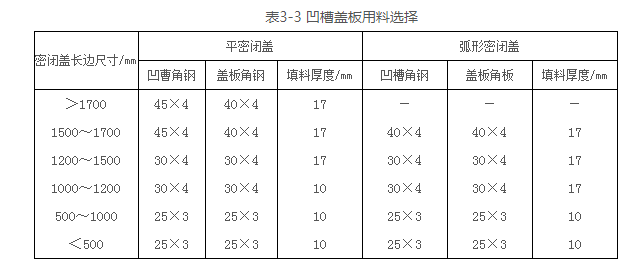
②The groove sealing filler should be made of elastic, durable, and inexpensive materials. Generally, silicone rubber sponge, non-asbestos rubber rope, foam plastic, etc. can be used. The compression rate of silicone rubber sponge does not exceed 60%, the temperature resistance is above 70-80℃, and 1kg can handle a gap of 8-9m of 40×17mm. The filler can be glued in the groove. ③The compression device is shown in Figure 3-14. It has four different types of connections, which can be combined according to actual needs. In the figure (a) is the connecting device with the closed cover that can be completely removed; (b) is the connecting device with one end still connected to the groove frame after the closed cover is opened; (c) is the large closed cover that is not frequently opened and closed Compression device; (d) is a compression device that frequently opens and closes or a small airtight cover. ④The groove sealing cover can be used according to the materials listed in Table 3-3.
(2) Measures to improve the tightness of the airtight cover ① Felt seals the shaft hole. The holes in the airtight cover that pass through the drive shaft of the equipment can be sealed with felt, as shown in Figure 3-15. ②Sand cover plate. Known to cover the holes that need to be opened frequently on the horizontal surface, as shown in Figure 3-16. ③ Flexible connection. Between the vibrating or reciprocating parts and the fixed parts, flexible materials can be used to seal, as shown in Figure 3-17, usually glued canvas or leather, artificial leather and other materials are used. When the operation of the equipment requires the flexible connector to have a greater expansion and contraction, the connector can be made into an accordion box shape. Three, cabinet type air collecting dust hood 1. Precautions for the design of cabinet type air collecting dust hood ①The exhaust effect of the cabinet hood is related to the uniformity of the wind speed on the working port section. The design requires that the wind speed of the cabinet mouth is not less than 80% of the average wind speed; when heat is generated in the cabinet at the same time, in order to prevent dusty gas from escaping from the upper edge of the working port, the air should be pumped on the cabinet; when there is no heat generation in the cabinet, it can be at the bottom Convulsions. At this time, the wind speed at any point on the working port section should not be greater than 10% of the average wind speed, and the lower exhaust port is close to the work surface. ②A movable sliding door is installed on the cabinet cover, but the sliding door shall not be allowed to completely close the opening. Figure 3-18 shows several commonly used cabinet cover forms. ③Cabinet hoods are generally installed in workshops or test rooms, and the airflow at the hood is easily disturbed by the environment. Usually, the exhaust air volume calculated at the recommended inlet speed is multiplied by a safety factor of 1.1. ④ The cabinet cover should not be located in the frequent traffic area, near the window or door. Prevent lateral airflow interference. When it is impossible to set up a separate exhaust system, the cabinet cover connected to each system should not be too many. It is best to set up the exhaust system separately to avoid mutual influence. 2. Calculation of the exhaust air volume of the cabinet hood Fourth, the external air-collecting dust hood When the source of harmful substances cannot be sealed or enclosed, an external air-collecting dust suction hood can be set, which uses the suction effect of the hood mouth to suck harmful substances at a certain distance from the suction port into the hood. The actual hood has a certain area. In order to understand the law of inhalation air flow, you can imagine that the hood is an inhalation point, that is, point and merge the suction port, and then extend it to the suction of the actual hood (circular or rectangular). The air flow is regular. According to these rules, the exhaust air volume of the outer cover can be determined. The outer cover has a simple structure and is convenient to manufacture, and can be divided into two types: upward suction type and side suction type. Since the shape of the suction hood is mostly similar to that of an umbrella, this type of cover is referred to as an umbrella cover. When using an umbrella cover, the installation height of the process equipment and the interference factors of the indoor lateral airflow should be considered. If necessary, fences, rotation, lifting and other improvement measures can also be taken. 1. Precautions for the design of the external air collecting dust hood ①The hood should be as close as possible to the source of pollutants without hindering the process operation. Avoid lateral airflow interference as much as possible. ②Add a flange around the exhaust hood opening to reduce the exhaust air volume. In general, the flange width is 150~200mm. |